The Imaginary, the Symbolic and the Real are an unholy trinity whose members could as easily be called Fraud, Absence and Impossibility.
Wikipedia, “The imaginary (psychoanalysis)”
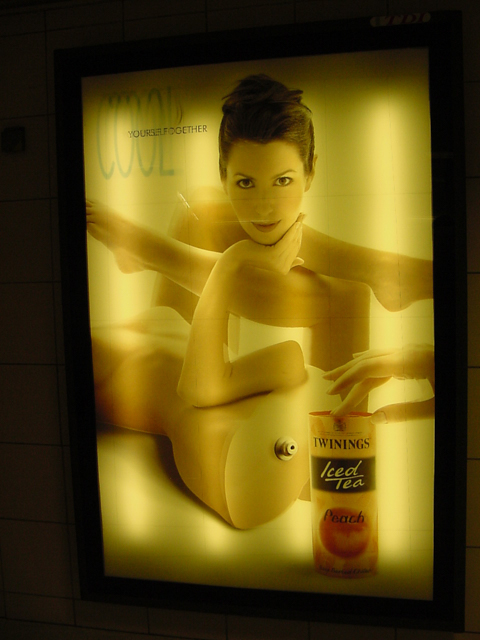
2.1 cool yourself together. London, July 2001
For Lacan, the driving-force behind the creation of the ego as mirror-image was the prior experience of the phantasy of the fragmented body … [Melanie] Klein’s “specific phantasy … that something inside the person is seeking to pull him apart and render him dead by dismemberment” fueled for Lacan “the succession of phantasies that extends from a fragmented body-image … to the assumption of the armor of an alienating identity”—to the ego as other-identification, as “fraud.”
Wikipedia, “The imaginary (psychoanalysis)”

2.2 I want lovely legs. Paris, August 15, 2002
Since the ego is formed by identifying with the counterpart or specular image, “identification” is an important aspect of the imaginary. The relationship, whereby the ego is constituted by identification, is a locus of “alienation,”—another feature of the imaginary—and is fundamentally narcissistic: thus Lacan wrote of “the different phases of imaginary, narcissistic, specular identification—the three adjectives are equivalent,” which make up the ego’s history.
Wikipedia, “The imaginary (psychoanalysis)”

2.3 the fetishism of commodities. Waihi, New Zealand, November 2000
With the increasing prominence of the Symbolic in Lacan’s thought … the Imaginary becomes viewed in a rather different light, as structured by the symbolic order. It is still the case that “the body in pieces finds its unity in the image of the other…[or] its own specular image” but no longer does “analysis consist in the imaginary realization of the subject” … Instead, “one finds a guide beyond the imaginary, on the level of the symbolic plane.”
Wikipedia, “The imaginary (psychoanalysis)”
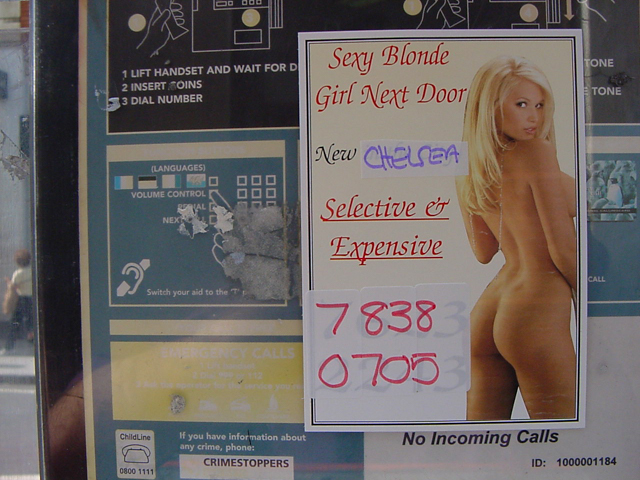
2.4 girl next door. London, July 2001
It also became apparent that the imaginary involves a linguistic dimension: whereas the signifier is the foundation of the symbolic, the “signified” and “signification” belong to the imaginary. Thus language has both symbolic and imaginary aspects: “words themselves can undergo symbolic lesions and accomplish imaginary acts of which the patient is the subject. “
Wikipedia, “The imaginary (psychoanalysis)”
Commentary
These photos were taken in rural New Zealand (2000), London (2001), and Paris (2002). They admirably illustrate André Breton’s contention that “surreality is contained in reality itself.”
Reminiscent of Hans Bellmer’s dolls, 2.1 was an advertising poster in a London Underground station; 2.2 and 2.3 are photos of shop windows. “Tart cards” advertising the services of sex workers (2.4) used to be ubiquitous in London’s telephone boxes until they were made illegal in 2001.
“By 2002 most convicted carders were receiving fines of £200–£1000, although persistent offenders were receiving jail terms of 28 days … British Telecom was removing 150,000 tart cards per week from central London telephone boxes and it had call-barred 500 of the telephone numbers used on tart cards” (Wikipedia).
I find it interesting that while the use of images of the female body (or parts thereof) to sell sex remains illegal in the UK and many other jurisdictions, its appropriation to sell anything and everything else remains an inescapable feature of our everyday capitalist banal.
 Camera lucida
Leave a comment