Je est un autre.
Arthur Rimbaud, letter to Georges Izambard, 13 May 1871
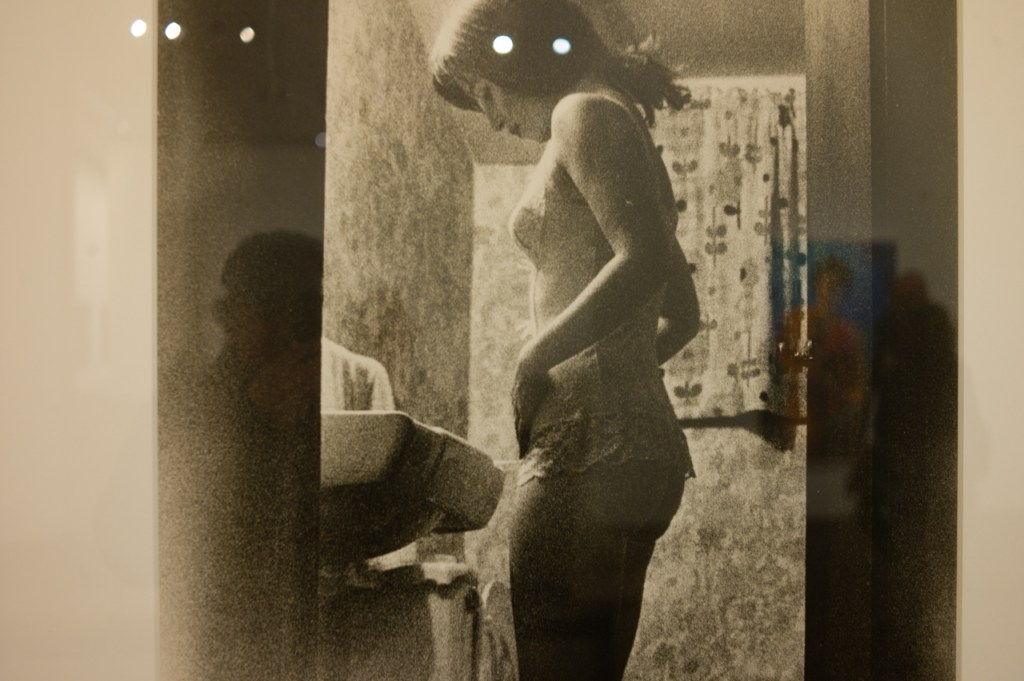
3.1 peeping tom. Berlin, March 15, 2016
The stills are dense with suspense and danger, and they all look as if they were directed by Hitchcock. The invariant subject is The Girl in Trouble, even if The Girl herself does not always know it. In Barbie-doll garments, in the suburbs or at the beach or in the city, The Girl is always alone, waiting, worried, watchful, but she is wary of, waiting for, worried about, and her very posture and expression phenomenologically imply The Other: the Stalker, the Saver, the Evil and Good who struggle for her possession.
Arthur C. Danto, introduction to Cindy Sherman: Untitled Film Stills

3.2 paparazzi. Berlin, March 15, 2016
She is America’s Sweetheart … The Girl We Left Behind, soft and fluttering in a world of hard menace; the Young Housewife, pretty in her apron, threatened in her kitchen; Cindy Starlet, Daddy’s Brave Girl, The Whore with the Golden Heart, Somebody’s Stenog, Girl Friday, with obstacles to meet, enemies to overcome, eyes to lift the scales from, hard hearts to soften, the Kid in the Chorus, love light burning in her big, big eyes, with a smile for everyone, a kind word for all, not a mean bone in her body, The Girl Next Door, Everyman’s Dream of Happiness.
Arthur C. Danto, introduction to Cindy Sherman: Untitled Film Stills

3.3 center/fold. Berlin, March 15, 2016
Things fall apart; the centre cannot hold;
W. B. Yeats, “The Second Coming”

3.4 regarding the pain of others
To find beauty in war photographs seems heartless. But the landscape of devastation is still a landscape. There is beauty in ruins. To acknowledge the beauty of photographs of the World Trade Center ruins in the months following the attack seemed frivolous, sacrilegious. The most people dared say was that the photographs were “surreal,” a hectic euphemism behind which the disgraced notion of beauty cowered. But they were beautiful, many of them …
Susan Sontag, Regarding the Pain of Others
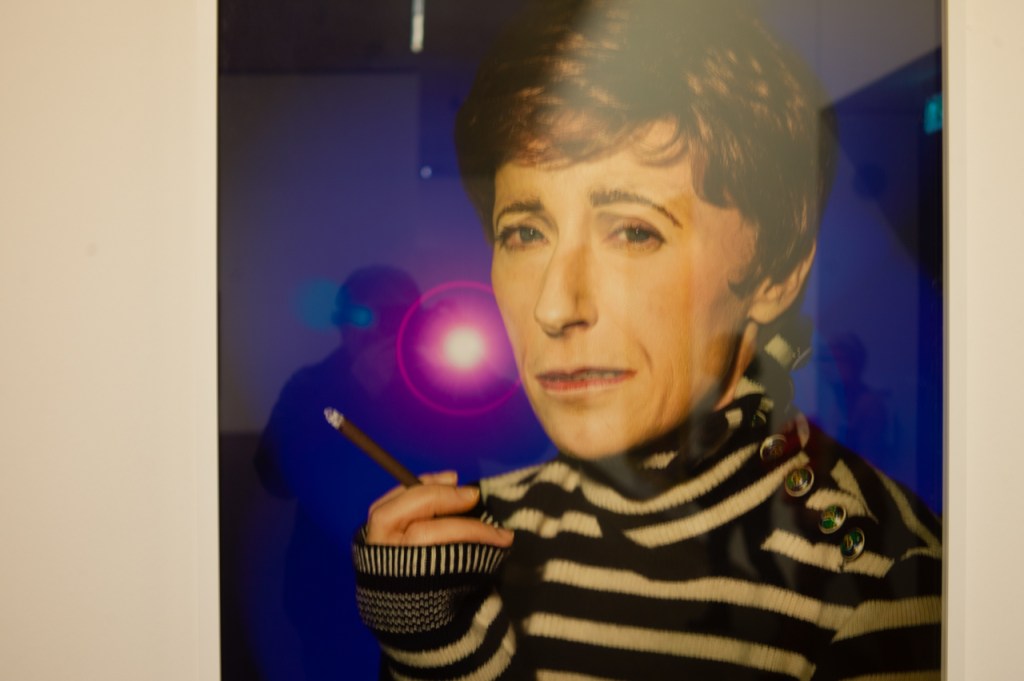
3.5 do not go gentle. Berlin, March 15, 2016
Old age should burn and rave at close of day.
Dylan Thomas, “Do not go gentle into that good night”
Commentary
The photographs in this essay, in which my own reflection lurks in the shadows like some stalking voyeur, were taken at the exhibition Cindy Sherman: Works from the Olbricht Collection at Me Collectors Room, Berlin, on 15 March 2016. It is likely the closest I’ll ever get to one of the great artists of our time.
Sherman’s entire oeuvre might be seen as an extended reflection on the enigma of identity, centrally through her self-portraits as somebody else. In the Untitled Film Stills series she impersonates archetypal characters from scenes in noir B-movies that never existed.
Her images are simulacra in Baudrillard’s sense—copies that have no original. In his words, ““It is no longer a question of imitation, nor duplication, nor even parody. It is a question of substituting the signs of the real for the real.” Centerfolds, from which the image in 3.3 is taken, is another of Sherman’s series.
Written in 1919, W. B. Yeats’s “Second Coming” expresses a quintessentially modern dread of the monsters modernity has unleashed. It is a key poetic staging post on the road that leads from Matthew Arnold’s “Dover Beach”—published in 1867, the same year as Karl Marx’s Capital—by way of Apollinaire’s 1914 calligramme “The Little Car,” to W. H. Auden’s “September 1, 1939.”
 Camera lucida
Leave a comment